The post The market is trading higher than we’ve seen in years, so why is it so hard to make marketing decisions? appeared first on Farm Girl Next Door.
]]>You know what the market did after that?
Skyrocketed.
That’s right. At the time, I thought we were reaching the top. Yet it just. kept. going. higher.
So of course, I kept looking back thinking, “Why didn’t I just hold onto it a little longer?!”
It’s a dangerous thing looking back on decisions. We want confirmation that we made the right decision, and we subconsciously seem to think we can pick the market high.
We can’t.
The same thing goes for grain marketing. Especially in years like this year where we hit new market highs, and then the market continues higher.
Unfortunately, when the market just keeps steadily creeping higher, it actually paralyzes you.
You’re nervous to make a decision because if you sold, you now see the $$ you missed out on as you watch the market surpass your selling price.
Even though you’re better off because you can sell additional grain for a higher price, it’s still hard not to think about what you could have made if you still had that grain to sell too.
So, is there anything you can do to help make the decision making process easier?
Here are three potential marketing options to consider:
1. Buy a call when you make a sale. Sometimes called a ‘courage call,’ buying a call option gives you the courage to make a sale because if the market moves higher, the call option will gain value. And if the market doesn’t move higher, you are just out the investment you made in the call option.
2. Set up a plan for an incremental selling strategy. i.e. set a price target to sell a certain quantity, then a higher price target for another set of bushels, and so on. You can even set firm bid offers with your grain buyer or broker for those price targets so the strategy can execute without your intervention. Those offers are really helpful when you’re busy – you just don’t have the time to watch the markets every second of every day!
3. Use an averaging contract with your grain buyer. These are handy because each day during the specified pricing window, an equal portion of the bushels you put on the contract get priced at the daily closing price. Thus, you get the piece of mind that you’re selling bushels every day. And, in most cases, you get to choose the pricing window.
All in all, it’s not easy to make decisions in this type of a market. It seems like it should be because prices are good and you can’t really go ‘wrong’ selling at these price levels, but it’s easy to get stuck in indecision.
If you’re stuck there, consider trying out one (or more!) of the marketing options mentioned above to help decrease the decision making pressure.
The post The market is trading higher than we’ve seen in years, so why is it so hard to make marketing decisions? appeared first on Farm Girl Next Door.
]]>The post Feeling apprehensive about your marketing plan pre-report? appeared first on Farm Girl Next Door.
]]>Here’s where me and the Farm Guy Next Door sit on the scale of risk tolerance: If we’re making a bet on something trivial, I’m more likely to bet $5-10. He’s more likely going to bet at least $50-100.
Now, my track record on winning bets with him isn’t great, so that might play into my low risk tolerance. However, I can attest that this holds pretty true across the board when it comes to taking on risk.
Regardless of whether your risk tolerance is similar to mine or the Farm Guy Next Door’s, I think we all get a bit of apprehension prior to USDA reports. Often, we display this apprehension by asking a variety of questions to people in the industry prior to the report:
“Do you think we’ll have a bearish or bullish report?”
“Do you think we should we sell more before report day?”
“So what if the numbers are bearish, isn’t there a weather story later this summer that could bring a rally?”
“What if we sell now and end up missing out on a rally?”
Here’s the deal. You can go round and round with these questions and you might never get the answer you’re looking for. We all love to talk, hear others’ opinions, and formulate our own. But remember, no one can predict the report. And if they do this time, watch out, because next time they probably won’t.
Usually, I find that people are stuck in a place of indecision.
Not willing to sell because they don’t want to miss out on a rally or are apprehensive about forward selling any more bushels.
But also nervous about doing nothing, because they worry the market will fall and they’ll have missed an opportunity.
So what do you do?
Let’s talk about options. If you’re stuck in a place of indecision and apprehension pre-report, a put or call might be something to explore depending on what you’re worried about or want to protect.
Put option: Provides downside price protection. With a put option, you lock-in a price floor so that if the market falls below the strike price of the option, you have the right to sell at a price higher than the market. Your risk of loss is limited to the premium and fees paid to buy the option.
Relating this back to your pre-report thoughts, if you’re in the camp of concern over unprotected, unsold bushels and your risk of market prices falling if the report is bearish, buying a put option might be a strategy worth looking into.
Call option: Provides an opportunity to benefit if prices rally. When you buy a call option and the market rises above the strike price of the option, the call gains value. However, if the market doesn’t rally, your risk of loss is limited to the premium and fees paid to buy the option.
Let’s bring this back to your pre-report thoughts. Maybe you’re thinking about selling some bushels before the report, but you’re on the fence because you don’t want to miss out if the report is bullish and the market rallies. Buying a call option allows you to mitigate your FOMO (fear of missing out)  and capture value if the market rallies. Having a call in place so you won’t miss out if there’s a rally gives you the confidence to make a sale.
Takeaways:
– Remember to focus on making decisions based on your marketing plan, breakeven, and profit goals. Don’t make marketing decisions that are just bets on report opinions/expectations – that’s not a risk management strategy.
– Talk to your commodity broker or marketing advisor to discuss and determine if buying a put or call would be a good strategy for you and your operation. Our operations are unique, so it’s important to understand what’s a good decision for YOUR operation specifically.
The post Feeling apprehensive about your marketing plan pre-report? appeared first on Farm Girl Next Door.
]]>The post This might as well be written in Spanish… appeared first on Farm Girl Next Door.
]]>“If ever there was a time to learn and utilize multiple marketing tools, it is this year. The near-term trend of sideways price action is providing you the opportunity now to position yourself with smart preplanned marketing decisions. Invest in the future by controlling volatility with the appropriate marketing tools that are right for you and your operation. A simplistic, yet balanced approach is to forward sell half your crop, buy puts on the other half, and buy calls to cover forward sales. You can confidently head to the field and have effectively positioned yourself for whatever way the market moves.”
– Bryan Doherty, Successful FarmingThis is an example of a well intentioned article about commodity markets. The shortfall? It requires that the reader has knowledge of the marketing strategies mentioned before he or she can get the most value from it.
When I read things like this, I have flashbacks to my high school Spanish class where we’d be given a short article, written in Spanish, and told by our teacher, “Just use context to decipher what unknown words mean in the text! This should not be that hard to figure out!”
And we all reacted with blank stares. It’s a little hard to use context when you only understand a few words in the whole article! He was grossly overestimating our existing knowledge.
The nice thing about this marketing article? At least it’s written in English.
My goal with Farm Girl Next Door has always been to write without the assumption that the reader has prior grain marketing knowledge.
So when I saw this article I thought, I bet someone read this and said to themselves, “I wish I understood the mechanics of calls and puts so I could explore that strategy further, because that section just went way over my head.”
So today, I’m breaking it down for you. Let’s re-look at part of the excerpt:
“A simplistic, yet balanced approach is to forward sell half your crop, buy puts on the other half, and buy calls to cover forward sales. You can confidently head to the field and have effectively positioned yourself for whatever way the market moves.”
Here are a couple of questions you might have when you read through this:
Q: What good does it do to buy puts on half of your production?
A: Put options protect a floor price.
If you’re worried the market might fall, you buy puts to limit your downside risk. Thus, buying puts on half of your bushels gives you piece of mind that you have downside price protection without having sales on the books. Instead of being entirely at the mercy of the market on the half of your production that is not forward sold, put options allow you to protect a floor price.
Q: Why would you forward sell half of your production and buy calls to cover those sales?
A: Buying a call option allows you to capture value if market prices rise.
Sometimes, you might feel nervous about forward selling too much because you don’t want to overcommit and miss out if prices rally. Buying call options gives you the courage to make forward sales. Why? Because when market prices rise, your call options increase in value. Thus, you can rest a little easier about making forward sales knowing that with bought calls in place, you won’t miss out entirely on increased value from a market rally.
I hope that helped give you more context…at the very least more context than what my high school Spanish teacher used to give us!
Be sure to send me an email (nefarmgirlnextdoor@gmail.com) if you run across something in an article about grain marketing that you wish someone would explain. It might just be the inspiration for another post like this!
The post This might as well be written in Spanish… appeared first on Farm Girl Next Door.
]]>The post Why we use offers to help execute our marketing plan appeared first on Farm Girl Next Door.
]]>I did what every good marketing advisor says you shouldn’t do.
I checked to see if there was a way to remove the firm bid offer we had in for $4.75 cash corn for February delivery to our local grain buyer when the market was getting close to filling it…
I can’t believe I just told you that because it goes against everything I believe in, but hey, it’s a new year.
And this year, I want to be more transparent around what we’re actually doing and thinking about when it comes to grain marketing on our farm.
This is real life for us, just like it is for you.
So why did I want to remove an offer that was about to fill for a price we’re targeting?
It’s on our marketing plan, it’s profitable, it’s a price we’re happy to receive after several years of poor prices…so what the heck?
Because I was letting my emotions get the best of me, that’s why.
I was sitting there watching the overnight trading session thinking,
“But what if it goes higher, we don’t want to limit ourselves?! Maybe we could get $5!”
I know better than that.
I know better than to let the emotion of a rally cloud my vision.
I know better than to think I should try to predict the market and ‘bet’ on higher prices when there’s an equally good chance it could go lower.
So after all that, here’s why I like offers and why I think you should consider using them if you don’t already.
Because I couldn’t take that offer out on Sunday evening, it filled. And then on Monday, when I was sooo nervous we were going to miss out on another big up day, the market finished lower.
And the cash price for February closed at $4.64.
So that’s why I like offers – they keep you disciplined.
If you’re new to firm bid offers or orders, here are a few key things to remember:
– Offers/orders can be used in the cash and futures markets:
You can put in offers with your grain buyer for a variety of cash contract types, or put in orders for futures or options trades with your commodity broker.
– FBO = Firm Bid Offer
A firm bid offer automatically executes (i.e. creates a contract) if the market trades through the price you were targeting with the offer.
– GTC = Good till cancel
The order will remain active and able to fill until you cancel it. So be sure you keep tabs on what active offers you have out there that could execute!
– To create an offer, you’ll need to decide on the price you’re targeting, contract or trade type, bushel or contract quantity, and the offer/order expiration date.
– Offers/orders can fill during the either the day time or overnight trading sessions
Use offers as a tool to help you execute on your marketing plan and stay disciplined. I know we’ll continue to do so on our operation.
The post Why we use offers to help execute our marketing plan appeared first on Farm Girl Next Door.
]]>The post Feeling Bullish? How to use a call option to capture value if the market rallies appeared first on Farm Girl Next Door.
]]>Let’s start by talking Pelotons, because who hasn’t been talking about Peloton bikes and home gyms this year…
What if back in January, someone bought an option for $50 that gave them the opportunity to buy a Peloton at $1,000? The option expires at the end of the year. At that time, they won’t have to buy the Peloton, but they will have the opportunity to. If they decide not to buy the bike, they’ll simply lose the $50 they paid for the option.
Today, the price of a Peloton is $2,000. If they choose to exercise their right, they’ll pay $1,000 for the bike (or $1,050 total with the cost of the option included, which is $950 less than the current list price).
Or, they could sell this option to buy the Peloton for $1,000 to someone else. If I were going to buy a Peloton, I can tell you I’d be willing to pay more than $50 to that option holder to have the ability to buy the Peloton for $1,000 instead of $2,000. While I’m not willing to pay them $1,000 (the value of the increase in the bike price) for the option, I’d still be willing to pay more than $50. Thus, the value of their option increased, just not penny for penny with the increase in the price of the Peloton.
Enough about the Peloton and me wishing it were cheaper…
Let’s talk about how you could buy a call option to capitalize on increases in futures prices.
A call option = the right, but not the obligation, to buy a commodity at a specified price.
You don’t have to exercise this option to buy the commodity on the underlying futures contract, but when you buy a call, you get the opportunity to exercise this right if you desire to do so.
If the market rallies, the bought call becomes more valuable.
You won’t capture the value penny for penny as the market moves like you would if you bought futures, but it will increase in value as the futures price appreciates.
Furthermore, your downside risk is limited to the premium you paid to purchase the option. Compared to buying a futures contract, buying a call is less risky. With a futures position, you would lose penny for penny if the market falls.
Example Scenario:
You sold soybeans at harvest but have been listening to the bullish sentiment in the market. You already sold, but you want a way to take part in the market and capitalize on futures price appreciation. However, you’re not willing to buy a futures contract outright and risk your position losing value penny for penny if the market falls.
So, you decide to buy a call because it will gain value if the market moves up, but you’ll only lose the initial cost of the option if the market falls and the call expires worthless.
12/1/2020:
The March soybean futures price is currently trading at $11.63. You buy one March soybean (SH21) call option (5,000 bushels) with a strike price of $12.00.
The cost to buy this call option is $0.30/bu.
12/21/2020
The market has been moving up since December 1st. It’s now December 21st, and SH21 is trading at $12.44.
The $12.00 SH21 call option is now worth around $0.70/bu.
Thus, if you decide to sell the option today, you would capture $0.40/bushel ($0.70 – $0.30).
Note: The call option doesn’t move penny for penny with the futures price change. Futures improved $0.81, but the value of the call option improved $0.40.
Just something to be aware of with options. Their value doesn’t move penny for penny with the market price moves.
Now that we’ve looked at an example, let’s recap some fast facts about call options.
Buying a call…
- means you have the right, but not the obligation, to buy the commodity on the underlying futures contract at the strike price of the option
- gives you an opportunity to capture value if the futures price appreciates
- limits your risk of loss to the premium paid for the option
- is a good strategy to use if you think the market will rally and you want an opportunity to capture value if it does, but want to limit your downside risk to the premium paid for that option
The post Feeling Bullish? How to use a call option to capture value if the market rallies appeared first on Farm Girl Next Door.
]]>The post Why should you be tracking cash bids? appeared first on Farm Girl Next Door.
]]>There, I said it. I’ll own up to it… And now the Farm Guy Next Door just heard (read) me admit it.
I have to write things down or else it’s like they disappear into thin air and are never found again. (i.e. some things the Farm Guy Next Door tells me and I fail to retain.)
Maybe that’s why I’m the self-proclaimed queen of to-do lists.
I love a good list. If something is written down, I won’t forget it. Not to mention, the list gives me something tangible to refer to and gives me the satisfaction of being able to cross things off.
When it comes to grain marketing, I’m not great at committing specific dates and prices to memory.
I’m not the girl who can answer questions like,
“What was the elevator paying in January?”
or “Exactly how much has the corn futures price moved in the last month?”
or “What was harvest basis back in July?”
off the top of her head.
What I can do, however, is find the answers if they’re documented.
And that’s the reason it’s so important to track cash bids consistently and regularly.
When I say ‘track cash bids,’ what I mean is to keep a record of what the bid was at a grain buyer for a specific delivery period on a certain day.
The frequency in which you track bids is flexible.
You could track bids daily for the grain buyers you care most about. Or, you could decide to track them weekly on the same day and time each week.
The important thing is to document the bids in a place that will make it easy for you to access and analyze. Personally, I like spreadsheets.
Tracking cash bids consistently helps you learn about the facilities you deliver to and understand price trends once you build up a data set.
Think about this, if you’re just starting to dabble in the marketing on your operation, chances are, you haven’t looked at the cash bid sheets for your local grain buyers for all that long.
Thus, it takes some time to get familiar and understand things like:
What’s the ‘typical’ basis level for harvest at the facility? When was the cash price for delivery in January at its highest over the last year? Has basis been steadily getting stronger or weaker since harvest? When was the best opportunity to sell our stored grain last year – did we miss out or did we sell something close to that price?
When it comes time to decide if basis is weak or strong, or whether the cash price is higher now than it has been for the past couple of months, how are you supposed to know?
By tracking bids, that’s how.
Here’s how to get started:
1. Pick 2-3 grain buyers (or more!) that you want to track bids for.
2. Pick the delivery period(s) you want to track.
i.e. Do you want to watch the spot price (AKA the price they’re posting for delivery for the current day), the harvest bid, and/or another delivery period you typically make sales during?
3. Each day, or each week on a specific day, document the full details of the bids you’re tracking from each buyer’s bid sheet.
4. BE CONSISTENT – I suggest setting a reminder in your phone
EXAMPLE:
Let’s say I’ve decided to watch the SPOT & HARVEST bids for the Cargill & ADM facilities near us.
I’ve decided to track cash bids every Monday at 3pm.
It’s 3pm on Monday, so I go to Cargill’s bid sheet and I copy down the bid information (delivery dates, futures price, futures month, basis, cash) for their spot and harvest bids for soybeans and corn in a spreadsheet.
Then, I access the ADM bid sheet and I copy down the same information for their spot and harvest bids in the spreadsheet.
For all bids copied down, I make sure to note the current date I documented them on.
Then, I do it all over again the following Monday…and the following Monday after that…
All in all, tracking cash bids will help you:
1. Become more familiar with your local market
2. Understand price trends
3. Create a resource to refer to when you have questions about when and how prices have moved or want to understand price trends
Wish you had a framework and someone personally leading you, step by step, through bid tracking to get you started?
I get it– I like more specifics and an easy to follow template too! Because of that, I have a whole module dedicated to teaching you how to track cash bids, step by step, in my new, online course that will be opening for enrollment on DECEMBER 6TH!
P.S. The course includes a bid tracking Google Sheet template too!
To stay up to date on the course details & to be notified when the cart is OPEN for signup, join my email list here! http://eepurl.com/gjiPEb
The post Why should you be tracking cash bids? appeared first on Farm Girl Next Door.
]]>The post Using Futures Pricing Orders During Harvest appeared first on Farm Girl Next Door.
]]>If you’re reading this in the tractor, it should provide you between 2-5 minutes of educational “entertainment.”
Over here, we just finished up beans and moved on to corn.
Considering we’re in the thick of harvest, let’s talk harvest marketing and a strategy that may be valuable for you to try.
In many cases, unless you can store all your production on farm, you’ll find yourself delivering grain that you don’t have forward sold.
When you don’t have a contract to apply the grain to, what do you typically do?
Well, most people choose to ‘spot’ the load, or sell it for the cash price at the end of the day.
Today, I want to give you another option to consider.
Have you ever used a futures pricing order?
A futures pricing order gives you more time to price futures on the grain you delivered, without paying storage.
Let’s work through the following:
1. How a futures pricing order works
2. Advantages & Disadvantages
How it works:
You deliver a load (or loads) of soybeans to the elevator today. For the sake of the example, let’s say you hauled in 3,900 bushels.
You think there’s a chance to capture a few extra cents on futures in the market environment we’re in. However, you’re busy and know you can’t watch the price fluctuations all day to catch it.
So what do you do?
You create and apply the 3,900 delivered bushels to a basis contract at $-0.65 SX0.
(side note: basis must be set on grain prior to or at delivery unless it’s being stored commercially, so that’s why we have to establish basis.)
Then, you put in a pricing order to price futures on the basis contract. You decide to put in the order $.07 above the current market price.
*Remember, the cash price equation is: Futures + Basis = Cash.
Futures and basis can be set separately to establish your cash price. If your futures pricing order fills, you will then have both components (futures & basis) set, and the cash price on the contract will be established at that time.
Here’s what your contract will look like:
bushels: 3,900
delivery: 10/5/20 (today)
basis: $-0.65
futures month: SX20
futures: —
cash price: —
Futures pricing order:
bushels: 3,900
price: $10.28 SX0
order expiration: 10/30/2020
*The futures pricing order will continue to run until it fills, until the expiration date you set on it, until you cancel it, or until you’re forced to price or roll the contract due to the expiration of the futures month.
Advantages & Disadvantages
Advantages:
- You give yourself more time to price futures and an opportunity to capture a higher price than what is posted today.
- You have the flexibility to change the price of the order or cancel the order at any time.
- The order executes without your intervention–you don’t have to watch the combine head with one eye and the markets with another and make a call to set futures.
- The order can fill in the overnight trading session.
Disadvantage
- The market may fall after today and you would’ve been better off spotting the bushels at today’s price.
If you decide using a futures pricing order sounds like something you’d like to do, give your local elevator or your marketing advisor a call.
I’m sure they’d be happy to explain it and answer any questions you have.
Just like all marketing options, evaluate whether this option is right for you.
Remember, just because we like to use futures pricing orders on our farm doesn’t mean they’re the right solution for everyone!
The post Using Futures Pricing Orders During Harvest appeared first on Farm Girl Next Door.
]]>The post What is the WASDE Report? appeared first on Farm Girl Next Door.
]]>When people start talking numbers with little description, do you simply start tuning it out and then realize you didn’t hear a bit of what was said?
No? Just me then… 
Crop reports contain a LOT of numbers and not a lot of explanation of how they relate to one another and how they impact you at the end of the day.
The August WASDE (World Agricultural Supply and Demand Estimates) report comes out TODAY, August 12th, 2020.
So before it’s released, I’ve put together a little summary about what this report is, why it’s important, and provided more context behind a few of the numbers that will be reported.
What is the WASDE?
Do you remember economics class and the coveted supply and demand curve?
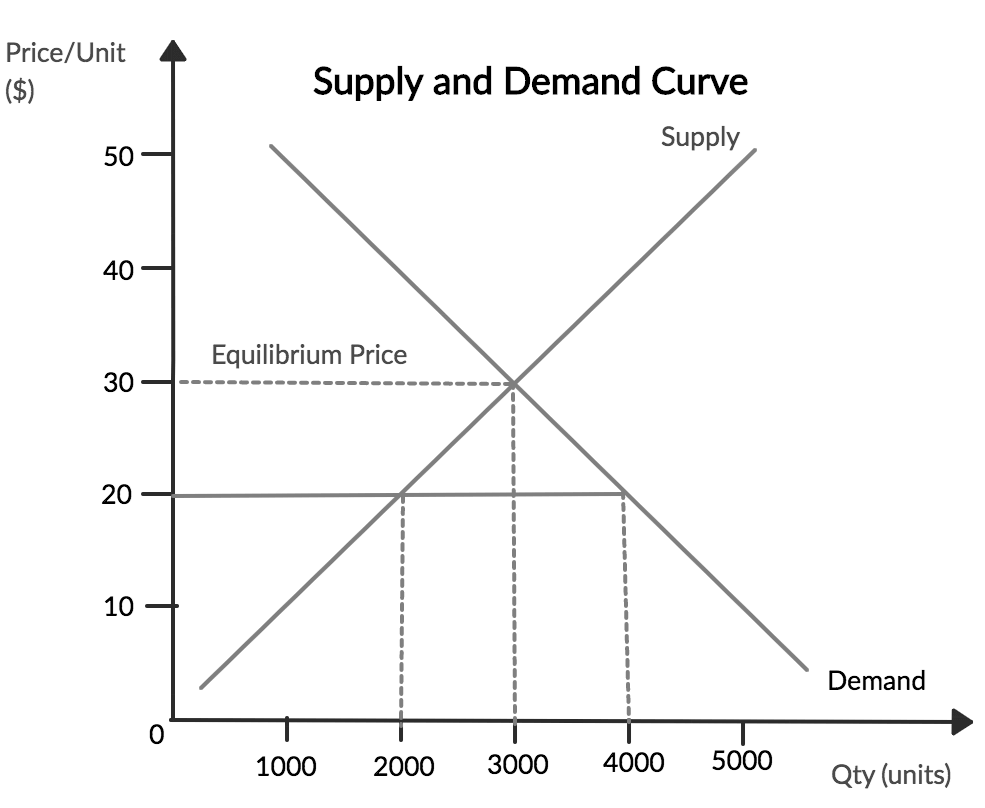
Well, the WASDE report provides the industry direction on where supply and demand stand for a variety of commodities:
U.S. and world wheat, rice, and coarse grains (corn, barley, sorghum, and oats), oilseeds (soybeans, rapeseed, palm), and cotton. Additionally, U.S. coverage also includes sugar, meat, poultry, eggs, and milk.
Keep in mind that, in line with economic principles, if we’re expected to have a big crop (i.e. large supply) without an increase in demand, we’re likely going to see lower prices.
Conversely, if we’re expected to have a difficult year and a small crop (i.e. short supply) and demand stays the same or increases, we’re likely headed into a higher priced environment.
Why is the WASDE important?
The supply and demand for each commodity is constantly changing, and the WASDE report updates us each month with the balance sheet for each commodity.
It provides individuals in the industry a common source for this information.
While analysts still have their own opinions, biases, and analysis they use to make trading decisions, the industry still looks to the numbers printed by the USDA in the WASDE as the baseline.
Whether you agree or disagree with the numbers the USDA prints in the report, there should never be a question about the amount of research and analysis that goes into putting this together. There is a lot that goes into this.
Here’s a snippet from the USDA website that describes all of the information that is gathered in order to determine the numbers that ultimately get reported:
“The National Agricultural Statistics Service (NASS) is the primary source of information on U.S. crop and livestock production and stocks, while information on foreign production is gathered from many sources including USDA’s Foreign Agricultural Service (FAS) attaché reports, official data released by foreign governments, satellite imagery, and weather data. U.S. agricultural trade data comes from the US Census Bureau and FAS. The Economic Research Service (ERS) compiles and analyzes information on domestic use, prices, and agricultural policy, and various types of data from the Agricultural Marketing Service, Farm Service Agency, the Energy Information Administration (within the Department of Energy), and other government agencies is also used.”
You can find more information about the report here: https://www.usda.gov/oce/commodity-markets/wasde/faqs
What do the numbers reported for each commodity mean?
Let’s take a look at an example from page 12 of the July 2020 WASDE and direct our attention to the section for U.S. Corn Supply & Use.
At the very top, always be sure to pay attention to the dates.
The column farthest to the right is the current projection, the second column from the right is the previous month’s estimates, and the third and fourth columns from the right provide the numbers from the previous year and 2 years prior for comparison.
It’s handy to have these values to compare to without having to pull each report individually.
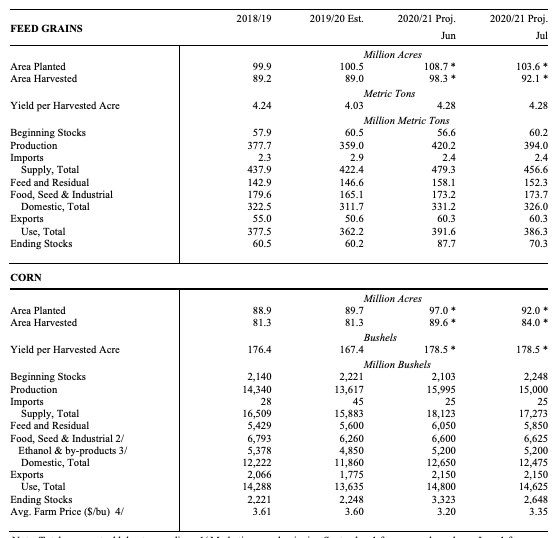
Considering I’m writing this prior to the August report, I’m going to provide more context around just three of the printed values that will be receiving a lot of attention this go around.
Yield: Considering the crop is still in the field, at this point yield is still a total estimate. Thus, the trade is watching this closely to see how the USDA is going to adjust the yield expectations from June. Up to this point, the crop has looked pretty good, so most analysts are expecting to see yield be ratcheted up.
Average analyst expectation for August: an increase up to 180.4 bushels per acre from July’s reported yield of 178.5
Production: This is another one that, because the crop is still in the field, is an educated guess at this point in the season. It tells us how much of the commodity is expected to be produced in the U.S. this growing season. Remember, higher production leads to a higher supply number, which usually keeps prices down.
Average analyst expectation for August: 15,182 million bushels, which is an increase over July
Ending Stocks: This is calculated by taking the Supply, Total – Use, Total. Thus, ending stocks tell us what we will be carrying over to next year. i.e. the amount we produced over and above what we are able to use. A higher ending stocks number is typically not favorable for prices.
Average analyst expectation for 20/21 ending stocks: 2,814
Again, this is an increase from what was reported in July
I hope that helped clear up some questions you had about the WASDE report, and to snag the report when it comes out, check out this link to the USDA’s website. https://www.usda.gov/oce/commodity/wasde
The report comes out promptly at 11 am CT and 12pm ET!
As always, if you have any other questions, please shoot me an email at nefarmgirlnextdoor@gmail.com!
The post What is the WASDE Report? appeared first on Farm Girl Next Door.
]]>The post What is ‘Old Crop’ anyways? appeared first on Farm Girl Next Door.
]]>I mean, if my corn’s been in the bin for 4 years, that’s getting up there in age, but selling in March after I just harvested it in October is considered ‘OLD?’
So that begs the question, “what do people mean when they refer to ‘old crop’ futures?”
First, be sure you understand what ‘new crop’ futures are for each commodity, which is all explained in this post.
‘Old crop’ refers to the futures months between the new crop months. In the old crop months, the crop that’s been stored from the previous harvest will be bought and sold prior to the next harvest.
Take, for instance, soybeans.
You’ll likely be harvesting soybeans in the calendar months of either October or November in the midwest.
Once those soybeans are harvested, they’re either sold right away as ‘new crop,’ or they’re stored, either at a grain buyer or in on farm storage, and become will be sold later as, ‘old crop.’
At some point, the ‘old crop’ soybeans in storage will need to be sold to make room for next year’s crop of soybeans.
Sales of old crop soybeans made between harvest in 2020 and harvest in 2021 will be sold against the old crop futures months.
For soybeans, the new crop month is SX and the the old crop futures months are:
SF: January
SH : March
SK: May
SN: July
SQ: August
SU: September
*Remember, there is not a futures month for every calendar month.*
Ok, now let’s do a couple of quiz questions to check your understanding!
1. If you contract and sell your soybeans for harvest delivery during October to your local grain buyer for a price of $8.75 SX20, is this a new crop or old crop sale?
2. If you store your soybeans and sell them in June of 2021 to your local grain buyer for a price of $9.01 SN21, is that considered a new crop or old crop sale?
Check your answers at the bottom and to keep it simple to remember what’s old crop and what’s new crop, remember the following:
1. There’s only one ‘new crop’ futures month for every commodity. Reference this post if you ever forget how to determine which month is ‘new crop’ for a commodity.
2. All other futures months for a commodity that are not the new crop month are considered old crop.
Answers:
1. new crop
2. old crop
The post What is ‘Old Crop’ anyways? appeared first on Farm Girl Next Door.
]]>The post What is Grain Marketing? appeared first on Farm Girl Next Door.
]]>It might surprise you how much I received this response when I would tell people I helped farmers market their grain.
It makes sense though.
When the term ‘marketing’ is used outside of the Ag industry, it is almost always used when discussing how to promote a product to buyers.
With a very commoditized crop like grain, however, farmers are price takers instead of price makers.
The corn or soybeans they are producing are not differentiated from the farmer next door. Unless, of course, they’re doing a non GMO, organic, etc. type crop.
Thus, marketing in the traditional sense of the word is typically used to promote and differentiate a product from competitors. That’s not useful in the ag industry with a commoditized product that does not have differentiating factors.
Thus, grain marketing refers to the process of selling a commoditized crop that a farmer produces.
Seems pretty straightforward and simple, right?
Well, there are actually several complexities. Below, I’ve listed a few of them.
A farmer doesn’t have to sell the crop at the same time that it’s harvested.
Rather, a farmer has the flexibility to lock in the price of the commodity before delivery, which is called ‘forward contracting.’ For instance, if I’m planning on planting 500 acres of corn this year and my average yield is 200 bushels per acre, I know that I’ll harvest approximately 100,000 bushels (500 acres * 200 bushels per acre) that I’ll be delivering at harvest.
Let’s say it’s June and I like the price that a grain buyer is posting for harvest delivered corn. In that case, I could choose to contract and lock in the price on a portion of my grain today, even though I won’t deliver it until harvest. Once I deliver it, I’ll be paid the price I established on the contract in June.
Farmers have different contract types they can use to sell their crop.
Many grain buyers offer several contract types that farmers can use. Instead of simply selling at the cash price that’s posted by a grain buyer, a farmer could use a contract type that just locks in their basis level or futures price, allowing them to set the other portion of the price later to establish their cash price. Or, some buyers also offer non traditional contract options that allow grain to be priced in different ways.
Grain can be stored and sold later.
Farmers have the ability to wait and sell grain after harvest if they have on farm storage. Or, some buyers offer commercial storage for a fee. I have some thoughts about using commercial storage…but it is still an option. Storage provides flexibility and potential opportunities for better prices after harvest.
There’s a futures market and a cash market.
This can get complex fast, so I’ll keep it simple. There’s the board price you see for commodities, which is the price you hear on the radio, see in the ‘futures‘ column on a grain buyer’s bid sheet, and is referred to when people say corn was ‘up’ or ‘down’ today.
The futures market is impacted by global supply and demand, global weather events in relevant commodity producing areas, economic factors, etc.
The futures market can be used to hedge, but farmers don’t physically deliver futures contracts.
The cash market refers to the bids that the grain buyers you deliver to post. For instance, the price the elevator down the road is paying for your grain on their bid sheet, is the price in the cash market.
The cash market is driven by local supply and demand, transportation costs, facility costs, etc. The cash market is where farmers sell and physically deliver their grain.
While this is a very high level overview of what grain marketing is, I’ll use future posts to help dive in and explain each of these items in more detail!
This post was written based on feedback from followers of Farm Girl Next Door, so if there’s something else you’re itching to know about grain marketing, shoot me over an email at nefarmgirlnextdoor@gmail.com or DM me on Instagram!
The post What is Grain Marketing? appeared first on Farm Girl Next Door.
]]>